Sunday, September 28, 2008

Biggest Carnivorous Aquatic Reptile

Biggest sea reptile discovered

God this is scary..

A 150-million-year-old sea reptile that grew to a massive 15m in length, has been discovered on an island in the Arctic, scientists announced today.

Nicknamed 'The monster', the creature was a pliosaur, a short-necked plesiosaur that lived in the world's oceans during the time of the dinosaurs.

'This is the first find of a significant portion of a whole skeleton of such a giant,' says Dr Angela Milner, palaeontologist (fossil expert) at the Natural History Museum. 'It will undoubtedly add much to our knowledge of these top marine predators.'

Arctic discovery

Norwegian scientists and volunteers from the University of Oslo Natural History Museum, discovered parts of the fossilised skeleton poking out of the side of a mountain on Spitsbergen, part of the Arctic island chain of Svalbard, in 2006.

On the look out for polar bears constantly, the team had to work through inhospitable arctic weather and by the end of the summer of 2007 they had finished their excavation.

Not only did they find a giant sea reptile, but they also uncovered parts of two other marine reptiles, a long-necked plesiosaur and an ichthyosaur.

Giant pliosaurs
Illustration by Tor Sponga of the giant sea reptile © Natural History Museum, University of Oslo, No

Illustration by Tor Sponga of the giant sea reptile © Natural History Museum, University of Oslo, Norway

They may have looked like dinosaurs, but pliosaurs were not: they were a group of plesiosaurs , extinct aquatic reptiles. Their short necks supported a huge skull full of an impressive set of teeth. They had a teardrop-shaped body and two sets of powerful paddles to help them swim through the water.

As the top predators in the sea at the time, they would have preyed on squid-like animals, fish and other marine reptiles.

One of the largest pliosaurs known is the Australian Kronosaurus that grew up to 12m.

Dr Milner adds, 'Pliosaurs were reptiles and they were almost certainly not warm-blooded so this discovery is also a good demonstration of plate tectonics and ancient climates. 150 million years ago, Svalbard was not so near the North Pole, there was no ice cap and the climate was much warmer than it is today.'

The team continues the slow process of cleaning and conserving the bones collected and will carry out further research to see if this giant, and the other reptiles, are new species.

Trilobites


INVESTMENT GRADE RARE COLORED KONEPRUSIA TRILOBITE WITH FREE-STANDING SPINES

Hamar Laghdad Formation - Erfoud, Morocco

DEVONIAN PERIOD: 395 - 345 million years ago

Amongst all the spiny trilobites, the Koneprusia trilobite looks like it was a living thorn bush. Its pleural spines even had spines on spines! This eerie creature certainly must have been a site to behold slowly inching its way across the ocean floor hundreds of millions of years ago. This stunning example comes from the Devonian limestone of the Atlas Mountains in Morocco.

Never before have we seen a more beautifully and perfectly preserved Koneprusia trilobite as this supreme grade example. Specimens like these come along on very rare occasions and the sum of all the spectacular features of this example is what truly puts it into an investment class. This is a large Koneprusia of the finest complete preservation with ALL GENUINE SPINES. The detail and quality of its painstaking preparation is the pinnacle of its kind. What makes this an ESPECIALLY desirable example is the NATURAL color of a dark olive black hue running down the length of one side with a dominating olive green hue existing on the other half. This coloration is naturally occurring and was a result of the mineralization process as this trilobite became fossilized. This color feature actually provides visual evidence of the authenticity and originality of the spines to this trilobite as the spines match exactly in color to the body and minute extremities which would be otherwise impossible to duplicate. The most common colors of trilobite fossils from this region and period are black or a dark olive black but the rare, bizarre occurrence of this coloration is the "piece de resistance" putting this Koneprusia into a once-in-a-lifetime ballpark for the serious collector. If you are demanding only the finest, 'non-fabricated' spiny trilobite specimens in your collection then you should seriously consider this magnificent specimen. This spectacular Koneprusia trilobite with all its spines is 100% genuine. The ORIGINAL spines from this creature have been painstakingly freed from all the limestone matrix to display this bizarre creature as it was when alive. The carapace is wonderfully preserved and is complete with original pustulose detail. The limestone is a natural butter yellow hue and has been carefully prepared to a stunning smooth surface with the trilobite raised up off the rock.

Using the finest modern micro-abrasive equipment and countless hours of 'nerves of steel' skill, each spine is original and natural, unlike the vast majority of spiny trilobites where the spines are fabricated from glue and resin. This example is a top choice and represents the finest Koneprusia trilobite with GENUINE SPINES freed from their matrix.

WARNING: There are several different grades of spiny trilobites on the market now with seemingly identical and very convincing appearances. Fakers have mastered producing 100% complete replicas of trilobites with free-standing spines. There are also classes of trilobites offered from the source that have varying degrees of fabrication such as a genuine trilobite but with all spines being fabricated. Prices generally will reflect the quality as the source preparators and sellers know the global prices and charge accordingly for the different degrees of authenticity of their specimens. Nevertheless, price should not be your only guide. Often, features such as thicker than normal spines and a dull, almost chalky appearance without any natural satin luster to the creature are some obvious signs of fakes. Know how to tell a genuine from a fake by reading this and rely ONLY on established professional sellers who have active experience in fossil preparation and will offer you an unconditional LIFETIME guarantee IN WRITING of the authenticity of the specimen.


Trilobites are hard-shelled, segmented creatures that lived hundreds of millions of years ago in the Earth's ancient seas. They are considered to be one of our planet's earliest complex life-forms and are one of the key signature creatures of the Paleozoic Era. Trilobites went extinct before dinosaurs even existed.

Next to dinosaur fossils, trilobites command a dedicated and passionate following amongst both scientists and fossil collectors, alike. In a relatively short time-frame (scientifically speaking, of course), we have the emergence and subsequent extinction of these fascinating creatures. Still most baffling is the incredible diversity of sizes and features that made up the trilobite group. Many bizarre species co-existed with highly specialized body parts that defy the theories of evolution in their "sudden" emergence and diversity during the Early Cambrian Period in what is known as the 'Cambrian Explosion'.

Trilobites were among the world's first arthropods, a phylum of hard-shelled creatures with multiple body segments and jointed legs (although the legs, antennae and other finer structures of trilobites only very rarely are preserved). They constitute an extinct class of arthropods, Trilobita, that is comprised of over 15,000 known species.

It has been reported that every year, four to five new species are discovered in the Atlas and Anti-Atlas Mountain regions in Morocco, alone! This desolate northern fringe of the Sahara Desert was once covered by a prehistoric ocean and its fossil deposits can be considered the world's richest and most diverse source of these ancient sea creatures.

Trilobites are the single most diverse group of extinct organisms that ever existed, period! The smallest known trilobite is just three millimeters long, while the largest type grew to a length of 70 centimeters (over two feet long!). The most common fossil of trilobites is the mineralized dorsal exoskeleton of the creature. This is found in partial form from molting (shedding the shell as it grows) or in complete form when the animal was buried and died intact. The soft parts of the underside are rarely preserved. The name 'TRILOBITE' means 'three lobed" and is derived from the fact these animals had bodies featuring three longitudinal lobes, not lateral (head, body, tail) as is often thought. The lateral division of three parts is shared by many arthropods, not just trilobites.

Considerable study has been done on trilobites as a whole organism. Even more fascinating though, is the research done on a microscopic level with regards to trilobite morphology. Radiographs have captured incredible detail of complete and fully articulated antennae and underparts like legs and gills, preserved in the host rock of some fossilized specimens. Perhaps the most impressive and classic feature of trilobites that comes to mind is the eyes. Microscopic studies of trilobite eye structures have also revealed marvelous adaptation and very high degrees of specialization in vision.

It seems that the more we learn about trilobites, the unfolding of their mystery is stranger than fiction. Certainly we gain a greater appreciation with each new discovery of these strange and highly advanced but now extinct 'butterflies of the ancient seas'.

AMAZING RARE PRIZED DUAL COLORATION - THE FINEST INVESTMENT GRADE OF THIS SPECIES ONE COULD OWN!

3.25" x 2" with original matrix, trilobite 1.85" long


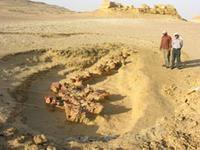
University of Michigan paleontologist Philip D. Gingerich and colleagues at the Egyptian Environmental Affairs Agency (EEAA) announced April 10 the successful excavation of an unusually complete and well-preserved skeleton of the 40 million-year-old fossil whale Basilosaurus isis.

The new skeleton is 18 meters (50 feet) long and was found in Wadi Hitan in the Western Sahara of Egypt. The first Basilosaurus fossil was found in 1905 but no full skeleton has been discovered until now.

The new skeleton of Basilosaurus will be shipped to Michigan for preparation and preservation, Gingerich said, via email. It then will be replicated in a casting material suitable for reconstruction and exhibition of the complete skeleton. The original fossil bones and a complete cast will be returned to Egypt for exhibition in public museums in Cairo and in the Wadi Hitan visitors center. Gingerich also hopes that a complete cast can be mounted in the University of Michigan Exhibit Museum.

The fossil whales of Wadi Hitan were first mapped in the 1980s and 1990s during expeditions led by Gingerich, a professor at the U-M Museum of Paleontology and Department of Geological Sciences. The 1989 team discovered that Basilosaurus still retained tiny, useless legs, feet, and toes representing hind legs that were lost at a later stage of whale evolution. No skeleton was collected at the time because of the remote location of Wadi Hitan and because of the large size of the whale skeletons.

whalebones_sm.jpg
Line drawing: Hans Theweissen
Wadi Hitan is a remote valley in which hundreds of fossil whale skeletons are being exposed by the wind. They lie trapped in a sandstone formation that represents an ancient sea bed. "Here the wind sculpts the sand into spectacular shapes, which give the valley an unusual beauty in addition to its richness in fossils," Gingerich said.

Wadi Hitan is a protected area administered by EEAA and is being developed as a national park by an Italian-Egyptian cooperative program. It also has been nominated as a UNESCO World Heritage Site because of its natural beauty and scientific importance.

Sea-living animals found in the Wadi Hitan desert include five species of whales, including the Dorudon atrox, presently exhibited in the University of Michigan Exhibit Museum. There are also three species of sea cows (Sirenia), two crocodiles, several turtles, and a sea snake, in addition to a large number of fossilized sharks and bony fishes.

This latest discovery is expected to enhance education about whales and geological history in Egypt. It will also help in developing and publicizing the network of national parks in Egypt, where President Hosni Mubarak is emphasizing preservation of natural resources by providing support for conservation of the natural environment.

"Basilosaurus is an enigma of whale evolution because of its unusually long serpentine body," Gingerich said. "The research team will use the new skeleton to study how it lived and swam, and possibly to learn why it is so abundant in Wadi Hitan."

The field research group working in Egypt now is led by Gingerich and includes doctoral student Iyad S. Zalmout of the University of Michigan department of geological sciences, Mohamed Sameh M. Antar and Gebely Abu el Khair of EEAA, and a team of eight assistants, all operating from a remote desert camp.

Field study of the fossil whales of Wadi Hitan is sponsored by the National Geographic Society and by the University of Michigan Office of the Vice-President for Research.

Source : The University Of Michigan

Top 12 Dinosaur Finds of All Time

Hundreds of years ago, we thought they were dragon carcasses. The truth was even more bizarre: A planet full of super-size creatures that ruled for 160 million years.

In the opinion of some of the world's top paleontologists, ranked in conjunction with Discovery Channel Canada newsroom staffers - here are our picks for the top dino finds of all time:


1. The dino-bird link
The notion that birds may be related to dinosaurs has actually been around for 100 years. But strong proof for the theory really started to reach critical mass in the 1970s and 1980s.

"Troodon - the largest-brained dinosaur with its stereoscopic vision and hands capable of manipulating things - gives us a lot of understanding about the transition from theropod dinosaurs into birds."

That's what Canadian paleontologist Philip Currie, one of the key proponents of the dino-bird link, told DiscoveryChannel.ca.


2. The first dino ever discovered
"The earliest finds were some of the most important, when scientists recognized these animals for what they were," says David Evans, Associate Curator in Vertebrate Paleontology at Toronto's Royal Ontario Museum. "The famous mistake that the early paleontologist Mantell made was to put the thumb spike of this animal on the nose," he says. The lizard-like appearance yielded the dino's name - Iguanodon. Though Mantell and others originally thought Iguanodon walked on all-fours, this is closer to current thinking on how many dinos moved.


3. T-rex soft tissue in-tact
After three years of excavating, researchers from the Museum of the Rockies in Bozeman, Montana, claimed their prize, a 70-million-year-old thighbone with what appears to be blood vessels, cells, and proteins involved in the formation of bone.

The find brought the question of whether or not we'll ever be able to clone dinosaurs back to the forefront: "Do you think we'll ever be able to engineer dinosaurs? Yes, but not the extinct species," Jack Horner, one of the world's most famed dino-hunters, told DiscoveryChannel.ca. Horner, who worked on the specimen with Mary H. Schweitzer of North Carolina State University in Raleigh, says he thinks we will be able to engineer characteristics and behaviors of dinosaurs.

"What technology and genetic sources do we already have at our disposal to make this a reality? Bird DNA. Birds are the descendants of dinosaurs, and carry various ancestral genes, as well as developing through ancestral characteristics during embryonic growth. What do we still need to get, or improve on? Figuring out which genes to switch on, and how to switch them. What are the major roadblocks? None other than time for experiments."


4. Dino mummies with in-tact stomach contents
Dinosaur "mummies" are exceedingly rare - even rarer amongst this handful of specimens with fossilized skin and organs still in-tact is a specimen with stomach contents preserved in a fossilized stomach.

Such is the case with "Leonardo" a Brachylophosaurus with 90 per cent of his skin and organs in-tact - more than any other dino discovered.

5. Ground-penetrating radar (allowed digs to commence before a tool ever hit the ground)
First widely used in the early 1990s, this technique lets paleontologists image fossils while they're still in the ground.

This gets the researchers a better idea of where they need to dig to excavate them and even being able to study the remnants of the animal to a degree without even having to dig.


6. "Sue" the most complete T-rex skeleton
A poster-child for the excitement that dinosaurs inspire, "Sue", named in 1990 after paleontologist Sue Hendrickson, is the largest, best-preserved, most complete fossilized skeleton of a t.rex.

"Sue" is also the most expensive, reported to have been bought for US$8 million.


7. "Lyuba" the frozen mammoth with skin and fur still in-tact
"Lyuba" is not only the best-preserved pre-historic animal ever found (with real skin, fur, organs and other tissues in-tact (not just fossilized) but the baby mammoth also raises the question of cloning.

While many experts insist a real-life "Jurassic Park" won't be possible in the near future - if ever - the same researchers admit that a "Stone Age Park" with cloned mammoths, saber-tooth tigers and other ice-age beasts may be possible.


8. The quest for the largest dinosaur ever
You can't really define one dinosaur from another as "biggest" - though many paleontologists agree you can break the search down to three categories: biggest, longest, heaviest.

The winners so far (guess which is which) are: seismosaurus, Argentinosaurus, and ultrasaurus.


9. Hollywood CGI
Jurassic Park revolutionized how dinosaur recreations are presented, but more specifically, the groundbreaking computer generated dinosaurs in the movie did so.

The technology quickly made its way into science documentaries such as the Walking With Dinosaurs series. You could argue that computer animations are a dinosaur's best publicist.


10. Dinos moved in herds
Not only did these creatures - from big sauropods to carnivorous hunting machines - gallop along in packs and herds, seldom alone. They also rarely - if ever - dragged their tales like their early stop-motion movie counterparts.

Some of the strongest evidence that dinosaurs almost always moved in groups is their tendency to die in groups - such as bone beds in the Alberta and Montana badlands, where dozens lay together.


11. They weren't necessarily stupid
Though we're a long way from decoding dinosaur brains even to the extent that we have with dolphins, whales, or even chimps, gone is the image of the dopey stegosaurus, with golf ball-sized brains.

In fact, many carnivorous dinosaurs had impressive vision and hunting techniques, as well as the ability to grasp and manipulate small objects.


12. Dino eggs with embryos intact
Paleontologists have gathered eggs, even whole nests and long suspected many of the in-tact ones could yield imagery of the embryos inside. In 2005, researchers at the University of Toronto uncovered two embryos in a series of eggs discovered in Africa.

The embryos revealed - among other things - that the 190-million-year old animals (Massospondylus carinatus) were born on all-four legs, not two as paleontologists previously thought.

Sources : Discovery Channel

Tuesday, September 16, 2008

Animal Kingdom Records

Hello, here I present to you some Animal Kingdom Records. Today, I feel like just writing about speed records. After various google searches and readings, the following are the said records.

Fastest Animal on Land

The fastest animal on land is undoubtly the infamous Cheetah. According to Google, the Cheetah or Acinonyx can reach speeds from 112 kilometres per hour to 120 kilometres per hour. The Acinonyx is known for the fastest land animal and its ability to accelerate from 0 kilometres per hour to 110 kilometers per hour in three seconds. Sadly, the Cheetah is ranked as an endangered animal due to predation by carnivores such as the lion and hyena. An interesting fact is that the Acinonyx cannot roar like other big cats but instead chirping, churring, growling, yowling and purring.

Fastest Animal that can travel the Longest Distance, Mantaining High Speed for the Longest Time

The record said above is held by the Pronghorn or American Antelope, which is a common prey for the animal mentioned above. The Pronghorn can reach speeds up to 86km/h. It is often regarded as the second fastest to the Cheetah. However, it can mantain high speed for a longer time compared to a Cheetah. The Pronghorn most probably evolved its running ability to escape from the recently extinct American Cheetah. Some interesting facts include that it is a very poor jumper and that by 1908, only 20,000 remaining Pronghorns existed in the world. But fortunately, humans protected their habitat and restricted hunting. This made the Pronghorn recover its number to 500,000.

The Fastest Bird Hunting

The Peregrine Falcon. An animal truely a gift from mother nature to us. The Peregrine Falcon, from the family Falconidae is often stated as the hunting dive, the stoop, which involves soaring to a great height and then diving steeply at speeds commonly said to be over 389km/h, and hitting one wing of its prey so as not to harm itself on impack. Fortunately, the Peregrine Falcon is an animal that is not endangered nor even slightly endangered.

Fastest Bird Flying

This record of the fastest bird flying is 100 mph per hour by none other than the Racing Pigeon. Otherwise known as the Racing Homer, the Racing Pigeon has been used to carry messages for centuries. Soon, competitions developed with pigeon racing growing into a popular sport throughout Western Europe. An interesting fact is that there is actually a fashion show made just for these beautiful birds.

Fastest Swimming Pinniped ( A mammal that swims with fins )

The California Sea Lion holds the said record. The number of the said pinniped is approxiametely 188,000 in the United States alone. Again, fortunately the sea lion is in no danger of extinction. The said sea lion can swim in the sea at up to 25 MPH, considering the fact that pinnipeds are usually slow.

Fastest Sea Starfish


This record belongs to the Sunflower Starfish from the Pacific Sea. Unlike any other starfish, this starfish moves the fastest, 75cm per minute. Though not much, this is considered a lot for a starfish. Their feeding behavior was filmed in the 2006 BBC nature documentary, Planet Earth. An interesting fact includes that in Monterrey Bay, California, the starfish feeds upon dead or drying squids.

Rekod Haiwan

Selamat sejahtera, sini, saya menulis beberapa rekod yang haiwan telah tercapai. Pada hari ini, saya rasa menulis tentang rekod kelajuan sahaja. Selepas carian melalui google, berikut adalah rekod tersebut.

Haiwan Terlaju atas Tanah

Haiwan terlaju atas tanah , tanpa ragu adalah Harimau Bintang. Harimau Bintang, atau "Aciconyx" dapat mencapai kelajuan dari 112 kilometer setiap jam ke 120 kilometer setiap jam. "Aciconyx" terkenal sebagai haiwan terlaju atas tanah sebab kebolehanya untuk memecut dari 0 kilometer setiap jam ke 110 kilometer setiap jam dalam tiga saat. Kesedihanya, Harimau Bintang diumumkan diancam kepupusan akibat dibaham oleh maging seperti Singa dan Hyena. Fakta menarik adalah Harimau Bintang tidak boleh menderu tetapi berkicau.

Haiwan Terlaju yang boleh bergerak pada jarak yang paling jauh sambil Memastikan Kelajuanya Sentiasa Laju pada Masa yang Paling yang Lama

Rekod ditulis di atas dicapai oleh Antelop Amerika, yang merupakan makanan utama Harimau Bintang. Kelajuanya boleh mencapai 86 kilometer setiap jam. Ia selalu dikatakan pemenang kedua kelajuan terpantas yang diberi kepada Harimau Bintang. Antelop Amerika menubuhkan kebolehan larinya untuk berlari daripada Harimau Bintang Amerika yang telah pupus pada baru-baru ini. Namun begitu, Antelop Amerika adalah haiwan yang berlompat dengan sangat teruk dan juga pada 1908, 20,000 antelop sahaja hidup dalam dunia ini. Tetapi, manusia dapat melindung tempat hidupnya dan melarangkan memburu antelop tersebut. Perkara tersebut menyebabkan Antelop Amerika meningkatkan bilanganya ke 500,000.

Burung paling Laju sambil Berburu

Burung Falko Belalang merupakan satu hadiah yang diberi daripada alam kita. Burung Falko Belalang , dari keluarga Falconidae menjunam untuk menyambar makananya. Kelajuan junaman tersebut yang paling laju direkodkan adalah 389 kilometer setiap jam. Kebaikanya, Burung Falko Belalang tidak diancam kepupusan.

Burung paling Laju Berterbang

Rekod ini dicapai oleh Merpati Balap dengan kelajuan 100 mph. Merpati Balap digunakan untuk menghantar surat selama berkurun-kurun. Tidak lama kemudian, satu sukan ditubuhkan iaitu, Lumba Merpati Balap dalam Barat Europ. Satu fakta menarik adalah terdapat satu fesyen tunjukkan untuk burung-burung yang cantik ini.

Anjing Laut yang Terlaju

Anjing Laut California dikatakan mencapai rekod tersebut. Bilangan Anjing Laut tersebut agak-agaknya 188,000 dalam Amerika Syarikat. Sekali lagi, Anjing Laut California tidak diancam kepupusan. Anjing Laut tersebut boleh merenang dalam laut sampai 25 MPH, walaupun anjing laut selalunya agak lambat.

Bintang Laut Terlaju

Rekod itu dicapai oleh Bintang Laut Bunga Matahari dari Laut Pacific.
Tidak seperti Bintang Laut yang lain, bintang laut ini bergerak dengan 75cm setiap minit. Namun tidak seberapa banyak, ukuran tersebut agak banyak untuk bintang laut. Sikap makan ia difilm di 2006 Dokumentari alam BBC, Planet Bumi. Satu fakta menarik adalah dalam Telok Monterrey, California, bintang laut memakan sotong maut atau dikering.

Friday, September 12, 2008

What is a Solar System?

A solar system is defined as a central sun with its associated planets, asteroids , meteors , satellites (i.e.,moons), and comets that are "captured" in its orbit. These various celestial bodies are trapped in a constant orbit around the sun by its tremendous gravitational pull. The paths that the planets take as they travel around the sun in the same direction - from west to east - is not truly circular, but more of an ellipse, or egg-shape path. Our solar system is nestled inside a very large galaxy of stars called the Milky Way. The outer limit of our solar system extends six billion kilometers from the sun.

Over 4.6 billion years ago our solar system was born when a nebula consisting of a dense nucleus, or protosun , surrounded by a thin shell of a gaseous matter and dust began to collapse in on itself. As the dense matter in the center of the solar system further condensed the extreme heat that was generated in the center began to burn the abundant hydrogen atoms in its core, becoming a self-sustaining nuclear fusion reaction that grew to be our sun. As the dust in the nebula circulated the newly forming sun, it collapsed and clumped together to form larger chunks of space debris. Larger and larger pieces of space debris collided with each other to form the solid planets, and the gaseous matter condensed to form the gas planets.


Apakah "Solar Sistem"?

Solar Sistem merupakan matahari dan planet, asteroid, kaji cuaca, satelit ( bulan ) dan komet yang ditangkap di dalam orbitnya. Badan sawawi yang berbagai-bagai tersebut ditangkap dalam orbit yang berterusan mengelilingi matahari oleh daya tarikan graviti yang hebat. Jalan yang diambil oleh planet ketika mengelilingi matahari dalam arah yang sama, barat ke timur, tidak bulat tetapi bujur atau jalan berbentuk telur. Solar sistem kami melendeh dalam sebuah galaksi yang sangat besar bernama Bima Sakti. Batasan luar Solar Sistem adalah sepanjang enam billion kilometer dari matahari.

Pada lebih daripada 4.6 billion tahun yang lalu, Solar Sistem kita lahir apabila nebula yang mempunyai nukleus tebal, atau matahari proto, terkepung oleh kulit nipis yang mempunyai perkara bergas dan habuk bermula merobohkan diri sendiri. Apabila nukleus tebal tersebut dalam tengah Solar Sistem memeluwap kepanasan lampau yang berlebih-lebihan dalam tengahnya, lalu menjadi satu reaksi cantuman nuklear yang menahan diri sendiri untuk menjadi matahari kita. Apabila habuk dalam nebula tersebut mengedar matahari yang baru dihasilkan itu, ia diroboh dan berkumpul lalu membentuk sampah-sarap angkasa lepas yang berbingkah.
Sampah-sarap yang besar berlanggar dengan sampah-sarap yang lain lalu membentuk planet pejal. Perkara bergas pula bercantum untuk membentuk planet gas.

References/Referens
http://www.extremescience.com/solarsystem.htm

Some Chess Tournaments Going On ( Beberapa Pertandingan Catur yang sedang dijalankan )

Recently , a chess tournament "Bilbao Grand Slam Final" has started and a total of six grandmasters from all over the world, Veselin Topalov ( Bulgarian ), Magnus Carlsen ( Norwegia ),Viswanathan Anand ( India ), Vassily Ivanchuk ( Ukraine ), Teimour Radjabov, ( Azerbaijan ) , and Levon Aronian ( Armenia ) have competed in a total of 9 games, ( so far ) with Veselin Topalov leading followed by Levon Aronian, Magnus Carlsen, Vassily Ivanchuk, Viswanathan Anand, and lastly, Teimour Radjabov. Bilbao is a city in Spain. The tournament will last from September 1 to September 13 and is a double round robin event.

The tournament is also one of the highest rated, because the average elo ( rating points ) is 2775.6 making it a category 22 tournament. Players get three points for a win, one point for a draw and zero points for losing a game. The prize fund for the event is 400,000 Euros, with the winner receiving €150,000, the second place €70,000, etc. with the 6th player getting €30,000. The sums are unprecedented for an event like this. Only World Championships have exceeded the amount.

References
http://chessbase.com/newsdetail.asp?newsid=4907

In other news, the Women's World Championship 2008 is taking place from August 28th to September 18th in Nalchik, in the Kabardino-Balkaria region of Russia. 64 players were eligible to play in the knock-out event, which has a prize fund of US $450,000. Due to the tensions in the region the Georgian players and a few others decided not to participate. The finals, were played by Koneru Humpy ( India ), Pia Cramling ( Sweden ), Alexsandra Kosteniuk ( Russia ), and Hou Yifan ( China ), ultimately, Hou Yifan, a 14 year old chess prodigy from China is leading with 4.0 points followed by Koneru Humpy (2.0 points), Alexsandra Kosteniuk (1.5 points) and Pia Cramling (0.5 points).

References
http://chessbase.com/newsdetail.asp?newsid=4907

About Me ( Pengenalan )

My name is Khalis Khalid. I live in Pulau Meranti. I study in Cyberjaya Primary School. I am in the top class though not the top student. My friends include, Mohd Asrul Hazwan ( the guy sitting next to me in class) , Viventhraa Sreenivas Rao, Mohd Najmuddin, Mohd Harith, Hijjas Kasturi, Yen Yee Hern, Mohd Izzudin and many more. A very important exam , UPSR ( Ujian Penilaian Sekolah Rendah ) had just finished , allowing me freedom. I guess i was a bit pampered as a child but recently i've come to realize that education is an important subject among students. Even so, with the remaining time when im not studying, I go on the internet.

Heres my school , SK Cyberjaya.
http://wikimapia.org/5663534/SK-Cyberjaya

Nama saya Khalis Khalid. Saya meninggal di Pulau Meranti. Saya bersekolah di Sekolah Kebangsaan Cyberjaya. Saya di kelas pertama tetapi bukan pelajar yang terpandai. Kawanku termasuklah Mohd Asrul Hazwan ( seorang yang menduduk bersebelahan saya) , Viventhraa Sreenivas Rao, Mohd Najmuddin, Mohd Harith, Hijjas Kasturi, Yen Yee Hern, Mohd Izzudin dan lagi. Satu peperiksaan yang amat penting , UPSR ( Ujian Penilaian Sekolah Rendah ) baru sahaja habis, membenarkan saya kebebasan. Saya rasa saya sedikit dimanja oleh ibu bapa saya terutamanya ibu saya semasa masih seorang kanak-kanak tetapi baru baru ini, saya telah sedar akan pelajaran satu perkara yang amat penting bagi seorang pelajar. Namun begitu, masa lapang saya menggunakan untuk melayari internet.

Berikut merupakan sekolah saya, SK Cyberjaya.
http://wikimapia.org/5663534/SK-Cyberjaya

Introduction ( Pengenalan )

Good morning, here , I express my thoughts and constant disagreements of the every day occurences . As you can tell, this is an extremely boring website, so please do shut the door when you have left. Anyway, here I post stuff that happened at my school or any other interesting stuff. When i'm bored, i'll probably just post what happened today. This blog is a mere life-saver for a bored boy of 12 years old living in Malaysia as the school holidays are approaching. I would like the blog to be in two languages, English and Bahasa Malaysia to improve my use of both languages.

Selamat pagi, di sini, saya menulis fikiran saya dan malar perguaman tentang kejadian setiap hari. Dengan itu, laman web ini amat membosankan, jadi tolonglah menutup pintu sebelum mengeluar. Di sini saya menulis perkara yang terjadi dalam sekolah saya atau apa-apa laman web yang saya rasa menarik perhatian saya. Apabila bosan, saya akan menulis tentang kejadian hari ini. "Blog" ini hanya satu perkara untuk menghilangkan kebosanan seorang berumur 12 yang meninggal di Malaysia kerana cuti sekolah menjelang tiba. Saya menginginkan "blog" ini ditulis dengan dua bahasa, Inggeris dan Bahasa Malaysia untuk meningkatkan pergunaan dua-dua bahasa tersebut.